)
Motor vehicles
As a business owner, you can claim a tax deduction for expenses for motor vehicles – cars and certain other vehicles – used in running your business.
If a motor vehicle is used for both business and private use, you must be able to correctly identify and justify the percentage that you are claiming as business use. The way you do this depends on your business structure.
Key points
- You can generally claim the running expenses of your motor vehicle which is used for business related purposes such as travelling between different business premises, visiting clients or picking up goods for sale.
- Types of expenses you can claim include: fuel and oil, repairs and maintenance, registration, insurance, interest on loan to purchase the motor vehicle depreciation (decline in value).
- If the vehicle is used for both business and private purposes you can only claim the business portion. Your are required to keep receipts and a log book to substantiate your claim for expenses.
Log books
- If you have more than one vehicle, keep a separate expense account for each vehicle so private use costs can be easily identified.
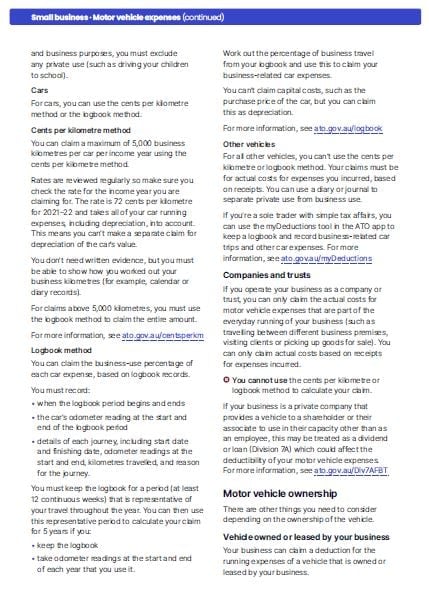
- Keep a log book for 12 weeks to record your business travel and use this to work out your percentage of business travel to claim your business related car expenses.
- Your log book records must include your car’s odometer reading at the beginning and end of the 12 week period and details of each journey.
- You can use the log book representative period to calculate your claim for 5 years as long as you keep the logbook along with annual odometer readings.
Trusts and companies
- If your vehicle is owned by a trust or company and available for private use by an employee or associate (eg spouse) fringe benefits tax may apply.
- From 1/7/22 employers do not pay FBT on eligible electric cars and associated car expenses.
- One method to reduce fringe benefits tax is to keep a log book to record your business usage.
- The private use of the vehicle may be exempt from fringe benefits tax if it is a vehicle with a carrying capacity of more than one tonne or not designed for the principal purposes of carrying passengers.
GST and depreciation limit (car limit)
- There is a limit on the amount of GST you can claim on the purchase price of a passenger vehicle (includes dual cab utes) unless it is designed to carry a load of more than 1 tonne or more than 9 passengers.
- This is know as the car limit.
- The maximum GST credit you can claim for the 2026 year is $6,334 ($69,674 x 1/11th).
- There is also a limit on the cost you can use to work out your claim for depreciation. The limit is $69,674 for 2026 year.
- The carrying capacity is the maximum loaded vehicle weight (gross vehicle weight) less the unladen vehicle weight (basic kerb weight).
ATO fact sheet



.jpg "More about Australian Bookkeepers Association")


